Placement matters more for sleep crystals than it does for most other uses.
During the day, you’re moving — carrying a stone in your pocket, picking it up and putting it down, actively holding it at moments of stress. Proximity to your energy field shifts constantly, and the stone adapts. Sleep is different. You’re going to lie in one position for seven or eight hours, mostly still, in your most receptive physiological state. Where the stone is relative to your body during that time isn’t incidental.
Most people put their sleep crystal on the bedside table because it seems obvious, and then wonder why they don’t notice much. Sometimes that placement is exactly right. Sometimes it’s the wrong choice for that particular stone, or for the specific sleep problem they’re dealing with. Before getting into positions, the foundation question is: which stones work best for different sleep problems — because placement optimisation only matters if you have the right stone to start with.
The Bedside Table
The default. Also, genuinely the right choice for most people, most of the time.
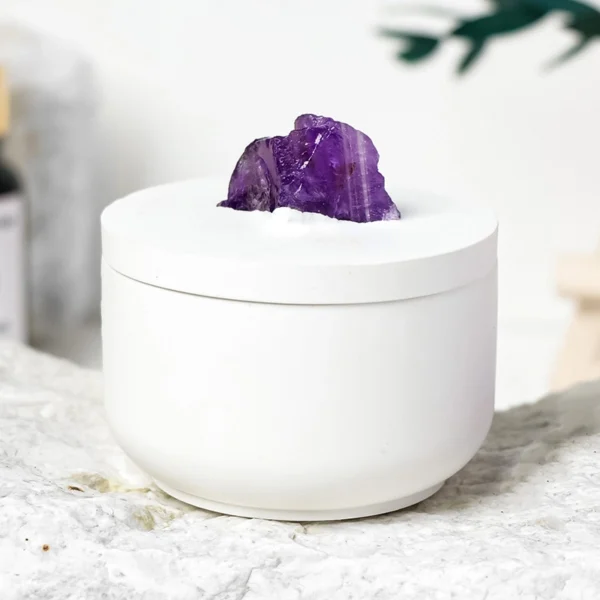
Stones that work at the mental and emotional layer — amethyst, lepidolite — produce their best sleep effects through sustained proximity to your head. The bedside table puts them within two to three feet of your head throughout the night. That’s close enough for the energetic field to extend into your sleep space without the stone being so close that sensitive people notice the energy as stimulating rather than calming.
A few things that change the equation. If your bedside table is on the other side of a wide bed — further than an arm’s length from where your head actually rests — it’s worth moving the stone to the nearest position. Energetic influence isn’t unlimited in range. Two feet from your head is meaningfully different from six feet.
If you share a bed and your partner has a different relationship with crystals — sceptical, uninterested, or actively bothered by the idea — the bedside table keeps the stone within your field without making it a shared object. That practical consideration is real.
Selenite is the one stone where bedside versus windowsill matters in a different way. Selenite’s work is environmental — it affects the room rather than you specifically. The bedside table isn’t wrong for selenite, but a windowsill position that lets it work on the whole room space often produces a more noticeable ambient effect.

Under the Pillow
More specific than most people realise. Not for every stone, not for every person.
The under-pillow position puts the stone in direct contact with your sleep field for the entire night. For stones that work primarily on the transition into sleep — the falling-asleep window, the shift from waking cognition to sleep — this proximity produces stronger effects than a bedside placement can. Howlite particularly benefits from this position because its work on overthinking is most needed during that precise threshold period.
The physical reality is also worth acknowledging. A large raw cluster under your pillow is going to create physical discomfort that disrupts sleep more than any crystal can help it. Tumbled stones in smooth, compact forms are what actually work under a pillow — small enough that you genuinely forget they’re there within the first few minutes of lying down.
For amethyst specifically, under-pillow versus bedside is a more nuanced question — the specifics of under-pillow placement for amethyst covers why the results vary more person-to-person with that stone than with most others.
Some people find that any stone under the pillow creates a subtle restlessness — an awareness of the object that keeps a thin layer of consciousness engaged. If you try it and your sleep is lighter rather than better, that’s useful information. Move the stone to the bedside table and see if that changes.
The Foot of the Bed
Underused. Worth knowing about.
Black tourmaline at the foot of the bed is the most common reason to use this position. The stone’s protective and grounding qualities work differently from the foot position than from a bedside placement — there’s a reason protective stones are traditionally placed at the boundary of a space rather than in the centre of it. The foot of the bed sits at the threshold of your most personal sleep space, and a grounding stone there creates the energetic boundary that makes the space feel distinct from the rest of the house.
If you find black tourmaline on the bedside table slightly activating — the grounding energy that’s useful during the day can feel just barely alerting when it’s close to your head at night — try moving it to the foot of the bed or the floor beneath the foot of the bed. For many people, this resolves the over-stimulation while preserving the protective effect.
Smoky quartz is the other stone worth mentioning here. Less commonly used for sleep than amethyst or howlite, it has a quietly grounding quality that produces less mental activation than black tourmaline at close range. A piece at the foot of the bed for people who feel ungrounded or restless during sleep — the kind of light, easily-disturbed sleep where you feel like you’ve been hovering just below full consciousness all night — is worth trying.
Room Corners and the Broader Space
The four-corner configuration — one stone in each corner of the bedroom — creates a contained energetic field across the entire room rather than a single point of influence. Selenite is the obvious choice here, and a piece in each corner maintains the ambient quality of the sleep environment around the clock rather than just during the night.
This isn’t necessary for everyone. If your sleep issues are primarily internal — a racing mind, anxiety-driven waking — corner placement of environmental stones is a secondary consideration to getting the right personal stone in the right position relative to your body. But if you notice the room itself feels heavy, or if you sleep better in other spaces and worse in your own bedroom, four-corner selenite is worth the experiment.
Practically, the stones don’t have to be large. A small tumbled piece or a selenite tower in each corner is sufficient. The configuration matters more than the size.

The Doorway
Less discussed, occasionally, exactly the right solution.
For people whose sleep disruption is related to what comes into the room rather than what’s already there — the residual energy of the day, the emotional tone of whatever happened before bed — a piece of black tourmaline just inside the bedroom door creates a filter at the entry point. The same logic as home protection placement is applied specifically to the sleep space.
This is distinct from the foot-of-bed position. Doorway placement addresses energy coming in. Foot-of-bed placement addresses the boundary of the sleep space itself. They can be used together.
One small crystal beside the bedroom door is enough. You don’t need a dramatic setup — a tumbled stone in a small dish, or simply placed directly on the floor just inside the threshold, is all this position requires.
The Windowsill
Two uses that are genuinely different.
The first is passive ambient placement — selenite or clear quartz on the windowsill, working on the room’s energetic quality over time. Selenite particularly benefits from this position because moonlight through the window provides ongoing natural cleansing without any effort from you.
The second is active placement for the under-full-moon charging practice. If you regularly charge your sleep crystals in moonlight, a windowsill that gets the moonlight is the obvious choice. Leave them out overnight during the full moon, and they’re cleansed and recharged for the following weeks of sleep use without any additional steps.
One thing to avoid: amethyst on a south-facing windowsill in a sunny room. The fading from UV exposure happens slowly but consistently. If the window gets strong afternoon sun, that’s not the right spot for your amethyst.
A Note on Quantity
More isn’t always better. This is something worth saying directly, because the natural tendency when sleep crystals don’t immediately work is to add more stones.
A bedroom with twenty-five crystals in it creates a complex energetic environment. That complexity isn’t inherently bad, but it does make it harder to identify what’s working and what isn’t. If you’re starting out, put one or two stones in carefully chosen positions, give it three weeks, and then adjust based on what you observe. Adding crystals gradually and intentionally is more productive than assembling a large collection and hoping one of them helps.

Caring for Bedroom Placement Stones
Sleep crystals need more frequent cleansing than stones in most other uses. Eight hours of close proximity during your most receptive state is energetically significant, and stones left uncleansed accumulate what they absorb. Monthly is the minimum. Fortnightly is better for stones under the pillow or held during sleep.
Moonlight is the most practical method for bedroom stones, specifically — leave them on the windowsill overnight when you have a clear sky. Smoke cleansing works for all of them. For how to cleanse bedroom placement stones and which methods suit each specific stone, this guide covers the safe options, including the important care notes for lepidolite and selenite, which cannot go near water.
FAQ
Where is the best place to put crystals for sleep?
It depends on the stone and what you’re trying to address. Amethyst and howlite work best close to the head — bedside table or under the pillow. Black tourmaline works better at the foot of the bed. Selenite works well anywhere in the room, including the windowsill. The matching table in our sleep crystals guide gives specific placements for each stone by sleep problem type.
How many crystals should I put in my bedroom?
Start with one or two in specific, intentional positions. Three at most initially. More than that makes it hard to know what’s working. Once you’ve found a combination that produces results, you can expand — but adding stones gradually and observing the effects is more productive than starting with a full collection.
Can I put crystals on the floor next to the bed?
Yes. Particularly for larger pieces or stones that work better at a lower energy level — smoky quartz and black tourmaline both work well on the floor at the foot of the bed. The floor position is especially practical for raw pieces that aren’t suited to bedside surfaces.
I rent and can’t make permanent changes. Does placement still work?
Completely. None of the placements described here requires anything permanent. Small dishes, soft pouches, and windowsill placement are all non-invasive. A crystal on a windowsill looks like a decorative object to anyone who doesn’t know otherwise, and under-pillow placement is invisible entirely.
My partner is sceptical. Can I still use bedroom crystals without creating conflict?
The bedside table on your side is entirely your own space. Under-pillow placement is personal and invisible. A single small stone in a dish requires no explanation to anyone. You don’t need to make crystal use a shared activity or a point of negotiation — the stones in your immediate sleep space affect your field rather than the whole room.
Does it matter which direction my bed faces for crystal placement?
In feng shui and some crystal traditions, cardinal direction affects placement choices. If that framework is meaningful to you, it’s worth exploring. If it isn’t, the practical factors — proximity to your body, stone-specific requirements, room layout — are a sufficient basis for good placement decisions. There’s no universal rule that overrides the basic logic of which stone works at which range.