The hardest part of getting into crystals isn’t finding them — it’s knowing where to start. Walk into any crystal shop, and you’re confronted with hundreds of options, each with its own name, colour, and set of claimed properties. Most introductory guides make it worse by listing thirty stones with no clear guidance on which actually matter for a beginner. Get all seven in one hand-polished collection — the 7 Chakra Merkaba Activation Set →
This guide cuts through that. If you’re not sure where to start within this list, a more focused starting-point guide narrows it down even further. For the complete landscape of how all healing crystals work together, our complete guide to healing crystals provides the broader context. But if you want to know which seven stones to actually begin with and why, this is that guide.
The seven stones here were chosen based on a specific criterion: maximum usefulness across the widest range of situations, with a gentle enough energy that they’re accessible to anyone regardless of experience level. None of them requires specialist knowledge to work with. All of them are widely available at reasonable price points. And together, they cover the main areas most people want to work with — calm, protection, love, clarity, energy, cleansing, and emotional healing.
What Makes a Good Beginner Crystal
Before the list, it’s worth naming the qualities that make a crystal appropriate for beginners specifically, because not all widely recommended stones meet these criteria.
A good beginner crystal is gentle enough not to overwhelm. Some stones — moldavite, black obsidian, labradorite — have intense, fast-acting energies that can surface difficult emotional material before a new practitioner has developed the context to work with what comes up. Starting with gentler stones builds the foundation first.
A good beginner crystal is also versatile. A stone that does one thing well in one specific context is less useful than one that works across daily carry, meditation, sleep, and space placement. The seven stones here all work in multiple ways without requiring elaborate setup.
Finally, a good beginner crystal should be easy to source in genuine form. Some sought-after stones are widely faked or adulterated at accessible price points. The stones below are all available as genuine specimens from reputable sellers without paying collector prices.
If the question isn’t which stone is best in general but which one is drawing you specifically, how to know which crystal is calling to you gives a framework for reading that draw accurately.
The 7 Essential Crystals for Beginners
1. Amethyst
Amethyst is the most consistently useful first crystal for most people, and the one most practitioners would choose if limited to one stone. Its calming quality addresses the problem that most people come to crystals looking to solve — mental restlessness, anxiety, difficulty sleeping, or a need for a quieter internal environment.
It sits at 7 on the Mohs hardness scale and is durable enough for daily handling and regular use. The purple colour comes from iron impurities within a quartz structure, and the depth of purple varies from pale lavender to deep violet depending on origin — both work equally well energetically.
The most immediate application for most beginners is sleep: a piece of amethyst on the bedside table addresses the specific problem of a mind that won’t settle at the end of the day. For meditation, it’s one of the most supportive stones available for beginners who find it difficult to quiet mental noise. Worn or carried through a high-stress day, it reduces the accumulated mental weight that builds up by evening.
For amethyst’s full healing properties and the complete range of what it does, that guide goes into the depth that a beginner guide can only summarise.
For people whose primary reason for using amethyst is anxiety specifically, our dedicated anxiety crystal guide covers how to use it alongside five other stones for different anxiety types.

2. Rose Quartz
Rose quartz is the heart-centred companion to amethyst’s mental clarity. Where amethyst quiets the mind, rose quartz softens the emotional layer — the self-critical internal voice, the habitual emotional reactivity, the places where love (for yourself or others) has become guarded or conditional.
The pink colour comes from traces of titanium and manganese within a quartz structure. Like amethyst, it’s widely available, durable at Mohs 7, and accessible at most price points. Pale rose quartz and deeper pink varieties carry the same properties.
For beginners, rose quartz is most immediately useful as an everyday companion during emotionally demanding periods — kept close during difficult conversations, placed on a bedside table during grief or relationship difficulty, or worn as jewellery where it stays in the energy field throughout the day. Its effects are gradual rather than immediate, showing up over days and weeks as a softening of emotional reactivity rather than a dramatic single shift.
The rose quartz complete guide covers everything from its historical context to the full range of practical applications.
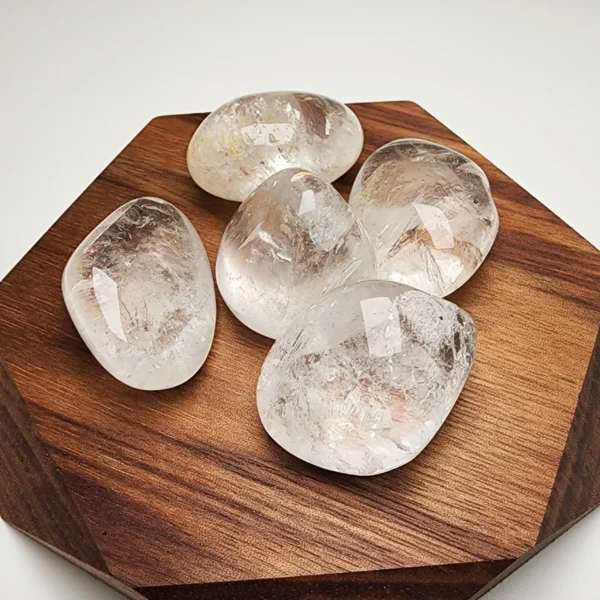
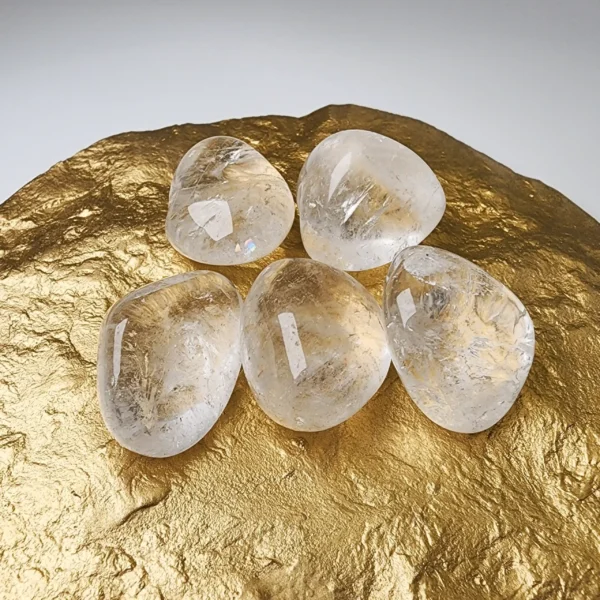
3. Clear Quartz
Clear quartz is the most versatile stone in common use and the one that amplifies everything around it — your own intentions, the energy of nearby crystals, and the focus of a meditation session. For beginners, this amplifying quality means that clear quartz functions as a multiplier: it makes the other stones on this list more effective when used alongside them.
It’s transparent to translucent, sits at 7 on the Mohs scale, and is stable under virtually all cleansing methods and environmental conditions. Its hardness and chemical neutrality make it one of the most robust common crystals for everyday handling.
The most useful beginner application of clear quartz is as an intention stone. Hold it in both hands, bring a clear mental statement of what you want to work with it on — the more specific the better — and allow the stone to act as an ongoing anchor for that intention throughout the day. Clear quartz doesn’t have a strongly directional energy the way amethyst or rose quartz does; it reflects and amplifies whatever you bring to it, which makes it one of the most adaptable stones for personal use.
4. Black Tourmaline
Black tourmaline is the protection and grounding stone in this set, and its effects tend to be among the most physically noticeable for beginners — a settling, anchoring quality that many people describe as feeling more present and less energetically scattered when carrying or near it.
It’s a boron silicate mineral with significant iron content, sitting at 7–7.5 on the Mohs scale. The ridged, striated surface of raw black tourmaline is characteristic of the mineral’s crystal structure and is visible even on polished pieces.
For beginners, the most practical application is daily carry — a tumbled piece in a pocket or bag keeps its grounding and protective qualities active throughout the day without requiring deliberate practice. Home placement near the front door creates an energetic boundary at the main entry point. Both uses work passively rather than requiring you to actively work with the stone, which makes it uniquely accessible for beginners who aren’t yet comfortable with meditation or intentional crystal practice.
For black tourmaline’s protective properties in full — including the reasoning behind its protective mechanism and the complete placement guide — that dedicated guide covers everything.

5. Selenite
Selenite earns its place in the beginner set not for its personal healing properties but for what it does for your other crystals: it’s one of the only stones that cleanses and charges the crystals placed near or on it without needing cleansing itself.
Practically, this means a selenite charging plate or wand is one of the most useful tools in a beginner collection. Leave your other crystals resting on selenite overnight, and they’re consistently cleansed without moonlight exposure, smoke, or water. For beginners who haven’t yet established a regular cleansing routine, selenite provides a low-effort default that keeps the collection maintained.
Selenite is also genuinely useful in its own right — its high-frequency, light quality creates a calm and elevated atmosphere in any space where it’s placed. Selenite wands and towers are among the most striking display pieces available, and their gentle energy makes them appropriate for any room, including bedrooms and spaces where children spend time.
The critical care note: Selenite is gypsum and dissolves in water. It’s one of the few crystals that must never be cleansed with water or even exposed to prolonged humidity.
6. Citrine
Citrine is the energising stone in this set — warm, uplifting, associated with optimism, creativity, and the kind of forward-moving energy that amethyst specifically doesn’t provide. Where amethyst settles and quiets, citrine activates and brightens.
Natural citrine is pale yellow to golden, coming from iron traces in a quartz structure. Much of what’s sold as citrine is heat-treated amethyst, which produces a deeper orange-yellow colour — both natural and heat-treated citrine are appropriate for beginners, though natural citrine is generally considered the more energetically consistent option.
For beginners, citrine is most useful as a workspace or creative environment stone — placed on a desk, in a studio, or in any space where energy, motivation, and positive outlook matter. It’s also one of the most commonly used abundance stones, placed in the financial corner of a space (front left from the main entrance in feng shui terms) with the intention of supporting prosperity and opportunity.
Citrine is one of the few crystals that’s considered self-cleansing, like selenite — though unlike selenite, it handles sunlight without damage and can be charged in direct sun for one to two hours.

7. Carnelian
Carnelian completes the set as the vitality and motivation stone — warm orange-red, grounding in a different way from black tourmaline, and associated with confidence, courage, and the physical energy to act on intentions rather than simply holding them.
The orange-red colour comes from iron oxide within a microcrystalline quartz (chalcedony) structure. It’s dense, non-porous, and durable — one of the most forgiving stones for beginners in terms of care, handling water contact, and most cleansing methods without issue.
For beginners, carnelian is most useful during periods of low energy, creative blocks, or situations requiring courage that feel beyond your current comfort zone. Held or carried during challenging presentations, difficult conversations, or any situation where physical confidence matters, it provides a steady grounding warmth that’s quite different from the mental calm of amethyst or the emotional warmth of rose quartz. It addresses a different layer of experience — the body and its will to act.
Your First Week: A Simple Starting Practice
Having the stones is one thing. Knowing how to begin using them is another, and the gap between the two is where many beginners stall.
The simplest starting practice requires nothing elaborate. Choose one or two stones from this list based on what feels most relevant to where you are right now. Cleanse them before first use — smoke cleansing with sage is the easiest method for a beginner, or leave them in moonlight overnight. For the full range of options, how to cleanse your first crystals covers every method with specific guidance on which stones can use which.
Once cleansed, hold each stone in both hands for a few minutes. Bring a specific intention to mind — not a vague wish, but a clear present-tense statement of what you want to work with this stone on. Then place it somewhere intentional: the bedside table, your desk, your pocket.
That’s the complete starting practice. Everything more elaborate — crystal grids, chakra layouts, complex intention rituals — builds from this foundation. Start here.
Common Beginner Mistakes Worth Knowing
Buying too many too soon. A collection of twenty stones with no established practice produces less benefit than two or three stones used consistently with clear intention. Start with three from this list, build a relationship with them, then expand.
Choosing based on appearance alone. A deeply coloured amethyst is beautiful, but pale amethyst with a clear energy quality serves the same purpose just as effectively. Learn to feel stones in your hand before purchasing, when possible — the visual and the energetic aren’t always the same.
Expecting immediate dramatic results. Crystal effects are gradual and accumulative for most people. The shift happens over weeks, not minutes — and it often shows up in retrospect rather than in the moment. Give each stone at least two to three weeks of consistent use before evaluating whether it’s working.
Neglecting cleansing. Crystals accumulate energy and need regular cleansing to maintain their effectiveness. For everyday carry stones, fortnightly smoke cleansing, or moonlight is the baseline. Leaving crystals uncleansed for months produces the energetic equivalent of never washing your clothes.
Understanding the difference between natural and synthetic crystals is also worth doing early — what that distinction actually means and whether it matters for your practice is covered in full.
FAQ
Do I need all 7 crystals for beginners to start? No. Start with two or three that resonate most with where you are right now. Amethyst and black tourmaline together cover calm and protection — a useful starting pair for most people. Rose quartz and clear quartz together cover emotional support and amplification. Build the collection gradually rather than acquiring everything at once.
Where should I buy crystals as a beginner? Physical crystal shops are the best starting point — you can handle the stone before purchasing, which is both practically useful and part of the intuitive selection process. For online purchasing, established sellers with detailed stone descriptions, origin information, and genuine photographs are the reliable indicators. Avoid marketplaces where the same generic product photo appears across dozens of listings at unusually low prices.
For the specific question of buying online — including what to watch for on Amazon — our guide to cheap crystals and what’s actually real covers the full landscape.
Do crystals actually work? Crystal effects are real in the sense that they’re consistently reported across millions of practitioners — but they work through mechanisms that aren’t fully explained by conventional physics. The most honest framework: crystals create a focused intention anchor. Whether the mechanism is purely psychological (physical objects consistently associated with specific intentions strengthen those intentions over time) or involves something more subtle depends on your perspective. The practical results — reduced stress, more intentional daily practice, shifts in emotional patterns — are real regardless of which mechanism you accept.
How do I know which crystal is right for me? Start with the problem rather than the stone. What do you actually want to work on — sleep, anxiety, confidence, emotional healing, or focus? Match that to the stone whose primary quality addresses it. If the energetic descriptions don’t resonate, choose based on physical attraction — the stone that draws you consistently is usually the right starting point.
Can I carry multiple crystals at once? Yes. Carrying two or three complementary stones together is common. A simple starting combination: black tourmaline (protection and grounding) + amethyst (calm) + clear quartz (amplification). The three together cover a broad range of everyday needs without creating energetic conflict.
How do I store crystals when I’m not using them? A soft cloth pouch, a wooden box, or a dedicated shelf or tray keeps stones together and protected. Avoid storing crystals loose together in a hard container where harder stones can scratch softer ones — selenite in particular scratches easily and should be stored separately from other crystals.